
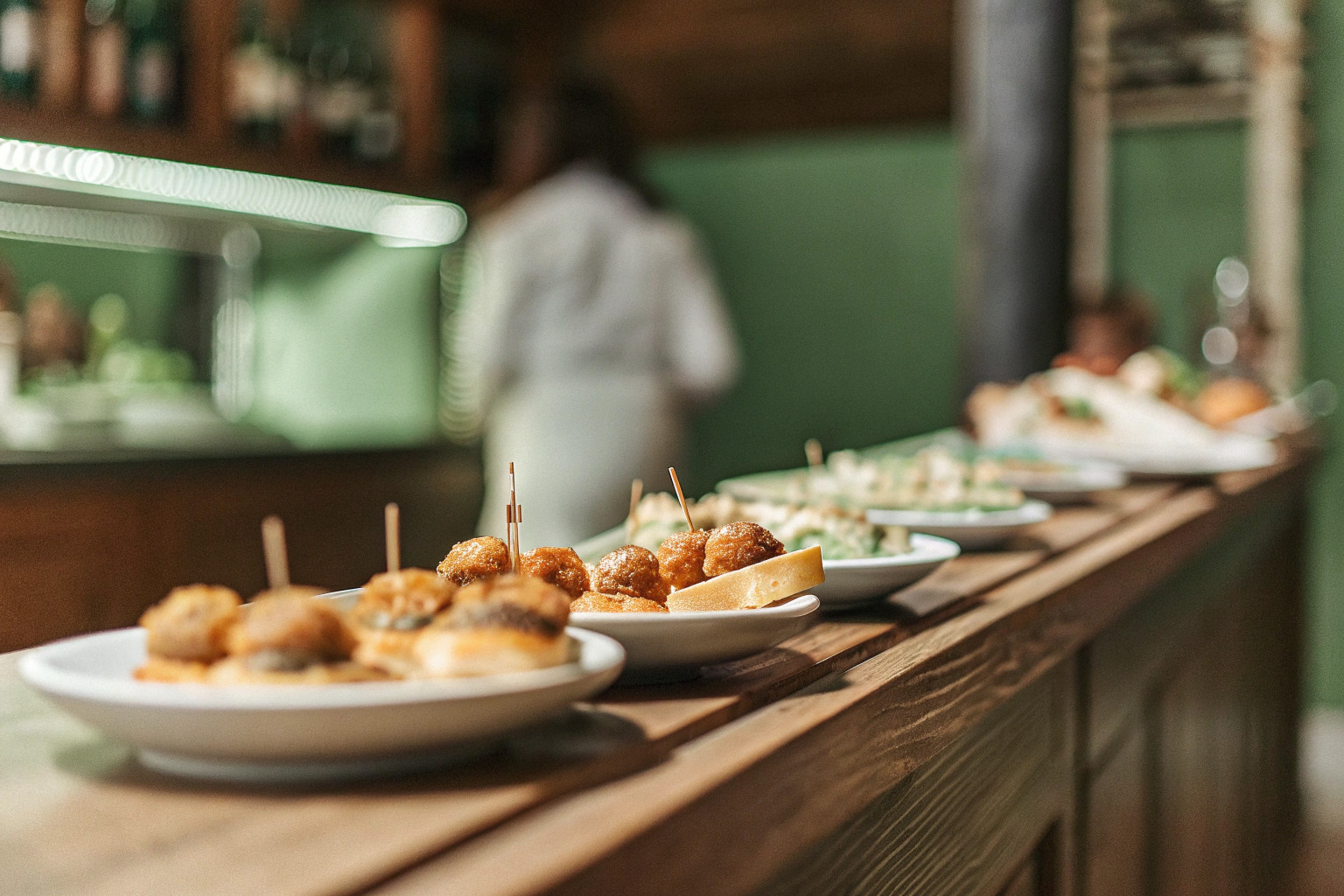
The Origin of Tapas
“Tapa” literally means “to cover,” and the origin legends all circle back to illness, insects, or sobriety. What started as a practical hack became a way of life, slow, shared eating that turns strangers into friends over endless rounds.
Fly-proof Legacy
One of the most charming (and practical) legends traces tapas to Andalusian bartenders, who started placing a slice of bread, cheese, or jamón over wine glasses to keep out flies and dust from coastal winds. The “tapa” (meaning lid or cover) kept drinks clean, patrons happy, and soon evolved into salty snacks that encouraged more rounds. A simple fix turned into Spain’s iconic bar culture.
Alfonso X’s Illness
Another legend has it, that in the 13th century, King Alfonso X of Castile (known as “the Wise”) fell ill and could only handle small sips of wine paired with light bites. To aid his recovery (and prevent overindulgence), he supposedly decreed that all taverns serve a small “cover” of food with drinks. From royal remedy to everyday ritual, this tale marks one of the most enduring origin stories of tapas.
A Modern Spanish Gastronomic Icon
Either way, tapas are a relatively recent phenomenon. In reality, tapas are not a timeless folk invention tied to kings or practical fly-prevention, but as a sophisticated, class-specific Seville innovation from just over a century ago that gradually became one of Spain’s most iconic and democratic food traditions.
This contrasts with the romantic folklore often repeated in tourism and popular stories. The term first appears in culinary contexts in the early 1900s. It is mentioned in a 1918 Spanish-American dictionary by a Cádiz author, and the Real Academia Española included it in 1939 (noting it as Andalusian by 1956). No pre-20th-century sources define “tapa” as a food item in this way.
From its Seville origins among the wealthy, tapas quickly spread across Andalusia and the rest of Spain in the 1920s with “Seville-style” tapas in other major cities. Tapas became further more widespread and democratised during the postwar years (after the Spanish Civil War), when economic hardship and rationing made full meals unaffordable for many. Bars offered cheap, small dishes to pair with drinks, turning tapas into an accessible, social “picoteo” (snacking) tradition enjoyed by all classes up until this day!
Leave a Reply