
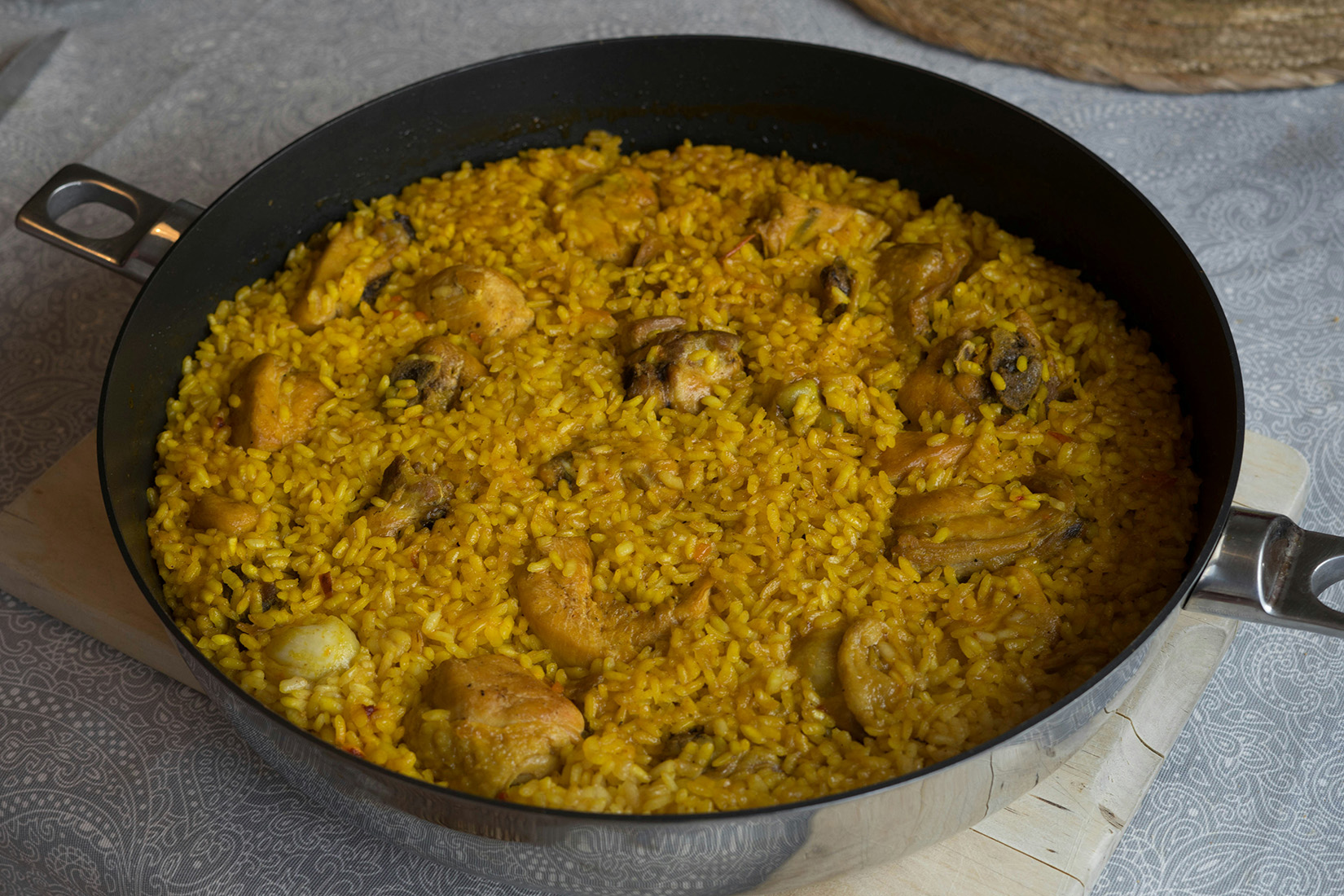
Don’t ask A.I about Paella
Paella is globally recognised as one of Spain’s culinary icons, but it is almost always universally depicted as a vibrant, ultra-colourful dish overflowing with large prawns, mussels, clams, squid, and other seafood arranged dramatically on top of bright yellow rice.
A simple AI, or old-school Google search for “Paella” will return a myriad of modern brightly coloured variations adorned with shrimp and lemons, like Paella de Marisco (with shrimp, mussels, clams) and Paella Mixta (combining meat and seafood), which are popular, but not considered the “true” authentic Pella, especially by Valencians.
In it’s true authentic form, Paella originates from the Valencia region and is very distinct from the seafood-heavy versions that dominate both the Internet, as well as tourist restaurants dotted all along the Spanish coastline. Even the inclusion of chorizo, as seen in recipes by chefs none other than the likes of Jamie Oliver, has also sparked heated controversy, with Paella purists arguing it deviates from tradition, and the heated debate only underscores the ongoing discussion about what constitutes “real” paella, with “Paella Valenciana” widely regarded as the original benchmark.
Historical Context
The history of Paella Valenciana can be traced to the 18th century in the Albufera region near Valencia, where rice cultivation, introduced by the Moors, was prevalent. Farmers and peasants created this dish using locally available ingredients, cooking over wood fires for their midday meals. The first documented recipe, named “Arroz a la Valenciana,” appears in a manuscript by Josep Orri, reflecting its origins as a simple, rustic meal. Over time, as rice became more widely available, paella recipes evolved, but Paella Valenciana remained focused on land-based ingredients, distinguishing it from coastal variations.
Sources such as Wikipedia and Food and Road confirm that Paella Valenciana was historically a dish of the inland regions, with early recipes including tomatoes, onions, snails, and beans, and occasionally rabbit, duck, or chicken, with saffron reserved for special occasions. This evolution underscores its roots as a practical, community-based meal, evolving into a cultural symbol by the 19th century, as noted in local Spanish newspapers.
“10 Commandments of Paella”
The official “10 ingredient rule” for authentic Paella Valenciana stems from a scientific study by researchers at the Universidad Católica de Valencia (published around 2021–2022), which surveyed the province to identify the consensus for core ingredients that must be included for the dish to qualify as traditional Paella Valenciana!
This has been widely reported as the “unwritten rules” or “10 commandments” of the dish, often referenced in Spanish media, by chefs like José Andrés and Rafael Vidal, and in discussions of protected or traditional recipes (including early attempts at a Denominación de Origen standard tied to Arroz de Valencia DO).
The 10 essential ingredients are:
– Arroz (rice, preferably short-grain Valencian varieties like Bomba, Senia, or similar DO Valencia)
– Agua (water)
– Aceite de oliva (olive oil)
– Sal (salt)
– Azafrán (saffron, or sometimes food coloring as a substitute)
– Tomate (tomato, usually fresh grated or crushed)
– Judía ferradura / bajoqueta (flat green beans, a Valencian specialty also called ferradura or tavella in some contexts)
– Garrofó (a large white/lima/butter bean variety, garrofón or garrofo)
– Pollo (chicken)
– Conejo (rabbit)
Preparation Techniques
The preparation of Paella Valenciana is a meticulous process, traditionally cooked in a wide, shallow pan called a paellera, which ensures even heat distribution and the formation of socarrat—the crispy, caramelized rice layer at the bottom, considered a mark of a well-made paella. Notably, seafood is absent from traditional Paella Valenciana, which emphasise that its inland origins preclude marine ingredients. This distinction is a point of contention, with purists criticising modern versions that include chorizo or seafood, often labelled pejoratively as “arroz con cosas” (rice with things).
Cultural and Social Significance
Paella Valenciana is more than a culinary dish; it is a cultural emblem of Valencian identity. Sources like Reddit’s r/askspain and Spain.info emphasise that paella is a social event, often prepared for gatherings, festivals, or family celebrations, symbolising unity and community. It is traditionally eaten straight from the pan, with each person using their own spoon, reinforcing its communal nature.
The dish also carries cultural debates, with purists insisting on traditional ingredients and methods, while modern interpretations, such as including seafood or chorizo, are criticised, both by leading Spanish chefs and the public alike. This controversy reflects broader tensions between preserving tradition and embracing innovation, with paella’s economic potential as a driver for tourism and cultural export, though challenged by both perception and ingredient availability abroad.
Paella Valenciana is a testament to Valencia’s culinary heritage, combining simple, locally sourced ingredients with time-honoured techniques to create a dish that is both rustic and refined. Its history, rooted in the 18th century, and its cultural significance as a communal meal highlight its role in defining Valencian identity. While modern variations exist, the authentic Paella Valenciana, with its chicken, rabbit, snails, beans, and saffron, offers a true taste of Spain’s inland traditions, inviting both locals and visitors to partake in a piece of cultural history.
Leave a Reply